When considering the roles that teacher librarians play in schools, collaboration is a huge key aspect in bridging gaps and making connections. “School librarians provide the all-important human connection between students and information, as well as between teachers and information.” (Riedling, 2019 pg 4) It is understood that librarians make connections with the students that visit the library, as well as connections with their fellow staff members, but when we speak of true collaboration we talk about a process of learning, and change. Teachers each have their own practice, and each decide on how they want to evolve their practice. Some choose deeper learning, leaping outside comfort zones, and welcoming innovation, others choose a more stagnant sort, a place of comfort and treading water. Every teacher experience is different, and every opportunity is unique, however, those that choose change, leaps and innovation will find that they make bigger impacts with their teaching.
When we look at the librarians, the library, students, and teachers we understand what connects them. We also understand what is generally expected for each within the library. What is often overlooked is the importance the librarian has on not only the library itself but the importance of promoting information literacy of her colleagues and students. Information literacy is generally defined as the ability to locate, evaluate, and use information found in a variety of formats to meet learning and information needs. As librarians we can only do so much in promoting this within the boundaries of our role, this is why collaboration between teachers and librarians is so vital, so that these skills that lead to information literacy can be taught and practiced.
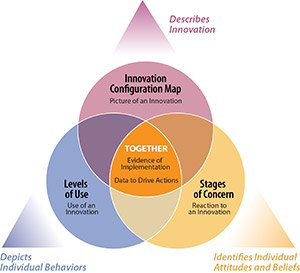
For the purposes of this assignment, two case studies of teachers were evaluated, and using the Concerns-Based-Adoption-Model were then aided in increasing their effective use of reference resources by working through the process and taking each teacher to a higher level of integration, embedding and application. The process for these two teachers will be laid out individually.
https://sedl.org/cbam/cbam-300.jpg
A Look at Teacher 1:
About:
“C” has been teaching for about 8 years. She’s a young energetic teacher full of ideas and willingness to try new things. She teaches grades 6 and 7, often doing split classes. She has great classroom management and teaches her students independence. She focuses a lot on project and the skills that come with being able to do them, as well as social emotional learning. She works in a school with a high level of needs, so she has grown used to adapting her teaching to fit many different learning styles. She struggles with resources in her classroom and finds little help in her school library. “C” spends a lot of outside time tracking down resources for her room, lessons, and projects. She finds curating resources a challenge. She collaborates, when possible, with other teachers that teach the same grades, but finds the environment for doing so not as welcoming.
She uses lots of technology in her room and often hosts an “iPad class” for the school year (where each student has an iPad), she struggles with teaching her students how to accurately use the internet and reference services to aid their learning. The lack in information literacy worries “C” that they will go into the next chapter of their learning journey with a limited knowledge of how to access information properly.
Evaluation:
In respect to effective use of reference services and the CBMA model, I would say that “C” is somewhere between an informational and a personal level. She is interested and would like to learn more to aid her practice and looking at how it will impact her and what her plan is moving forward.

“C” main problem is the lack of support in both collaboration and resources. She feels stuck on where to start but is eager in starting.
Innovation Configuration: providing a well-defined picture of what constitutes stellar—and not so stellar—implementation of a program. ("Innovation Configurations, A Dimension Of The Concerns-Based Adoption Model (CBAM)")
Effective use of reference resources – this is the goal for “C”.
- Accesses relevant and accurate recorded knowledge and information (adapted from professional competencies for reference and user services librarians, www.ala.org/rusa/resources/guidelines/professional)
Aiding and Directing:
Clear and accurate information needs to be made for “c” in what effective use of reference resources are. What do they look like, and how will it be known that they are achieved. A chart or rubric can be made amongst the teachers in that grade range, as well as with the TL. Each aspect of the chart can be focused on one step at a time. Collaborative co-planning lessons with the TL as well as opportunities to visit teachers in other schools who are masters/experts/or even just comfortable teaching effective use of reference resources can be arranged. Check ins on a weekly basis with TL allows “c” to stay on track as well as ask questions. This will hopefully lead her to a concern of management or consequence (changes in routine, and how much time will this need).
Levels of Use interview tool can help determine how well the implementation of effective use of reference resources is going. At the beginning “C” will most likely be sitting at an orientation level of use, meaning that she is discussing at looking at materials and considering using it in the future. After discussion, connections, and a well-developed outline for what the goal will look like, “C” will be moving towards a preparation level of use for this innovation.
A Look at Teacher 2:
About:
“F” is a veteran teacher. She is close to retirement and has worked at her school for over 20+ years. She is comfortable in her role, and comfortable in how she chooses to teach. She has great classroom management, although struggles to adopt new strategies and techniques for social emotional learning, more so due to refusal to adapt rather than the content being challenging. She runs a tight ship, so to speak and is firm but kind. She adopts a more traditional role of learning in her classroom, often preferring the use of textbooks over anything digital. She is happy to collaborate with teachers of similar style and enjoys mentoring teachers. She has a firm belief in information literacy in terms of physical materials. She puts a big focus on reading and writing in her room, spending lots of time teaching students how to read, understand and answer prompts from books. She has a digital projector easily accessible in her room, as well as a laptop.
The amount of information, programs and skills needed to start using technology is too much for her, and she finds keeping up with everything new too challenging.
Evaluation:
In respect to effective use of reference services and the CBMA model, I would say that “F” is at a Management stage. She is well established in the idea of using reference resources effectively but lacks the digital aspect to it. She is concerned about how a new approach (ie using digital resources) will take time and effort from her teaching.

Innovation Configuration: providing a well-defined picture of what constitutes stellar—and not so stellar—implementation of a program. ("Innovation Configurations, A Dimension Of The Concerns-Based Adoption Model (CBAM)")
Effective use of reference digital resources – this is the goal for “F”.
- Accesses relevant and accurate recorded knowledge and information (adapted from professional competencies for reference and user services librarians, www.ala.org/rusa/resources/guidelines/professional)
Aiding and Directing:
Address the “how to” concerns. Give opportunities to work with other teachers. Mini Workshops or lessons on digital resources will be effective for “F”. Exact steps, and solutions will be the most beneficial. “F” should consider working with one database/resource to start. Allowing students to use a digital resource for a familiar project or lesson can allow a chance for “F” to work out the details, while still maintaining her teaching.
Levels of Use interview tool can help determine how well the implementation of digital use of reference resources is going. “F” will probably sit around the refinement/routine use aspect of levels of use. She is comfortable with the resource use but needs to refine her practice with the use of technology.
Conclusion:
The three components of CBAM: Innovation Configurations, Stages of Concern and Levels of Use allow these two teaches to gain new skills, while addressing their concerns, and supporting them in each step of the new implementation of this innovation (effective use of reference materials). Opportunities for teachers to improve and collaborate is important, and with mentors like this program or a TL, they can seek support. A huge part of being able to make a decent change in the library is developing an open library and the values and beliefs of a library learning commons. By allowing teachers to collaborate, to use the library for things other than book exchange we can open the flow of information, and make teachers feel more comfortable in coming and asking questions on how to improve their practice. A teacher librarians role in the library is to promote stratgeies, and teach skills for learners (student and teacher). In both these looks at teachers, a main obstacle was the fact that neither teacher had a relationship with their library or teacher librarian, and that is one of the biggest factors in the changes.
References
"Concerns-Based Adoption Model (CBAM)". Sedl.Org, https://sedl.org/cbam/.
"Innovation Configurations, A Dimension Of The Concerns-Based Adoption Model (CBAM)". Sedl.Org, https://sedl.org/cbam/innovation_configurations.html.
"Professional Competencies For Reference And User Services Librarians". Reference & User Services Association (RUSA), https://www.ala.org/rusa/resources/guidelines/professional.
Rieding, Ann Marlow, and Cynthia Houston. Reference Skills For The School Librarian. 4th ed., Libraries Unlimited, 2019.
"Summary - Concerns-Based Adoption Model". Sites.Google.Com, https://sites.google.com/site/ch7cbam/home/summary.


